

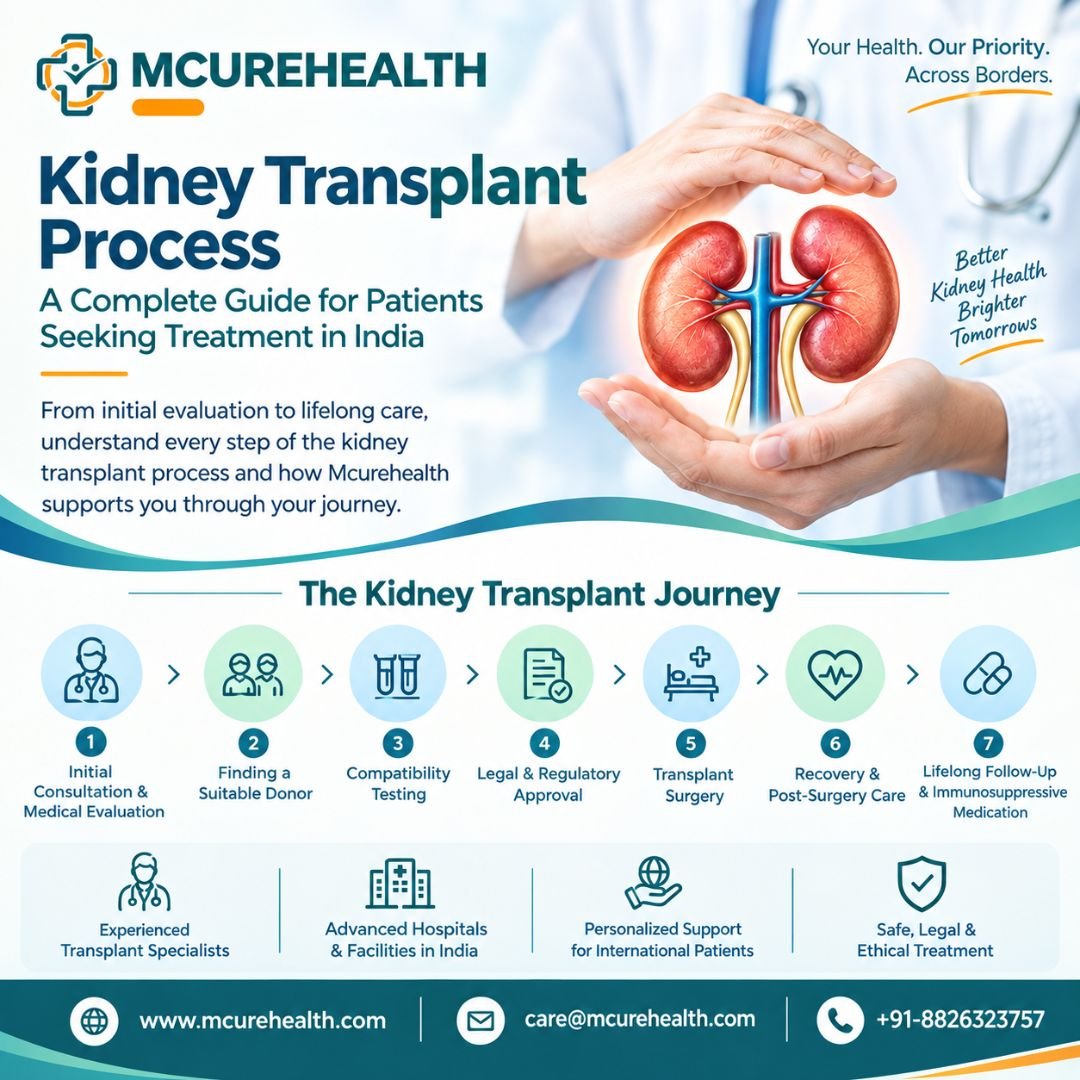
Kidney Transplant Process: A Complete Guide for Patients Seeking Treatment in India
- September 14, 2026
- 0 Likes
- 7 Views
- 0 Comments
A kidney transplant is a major medical procedure that can offer a new lease on life to people with advanced or end-stage kidney disease. For patients whose kidneys can no longer perform their essential functions adequately, transplantation may provide an alternative to long-term dialysis and can help improve quality of life.
India has become an important destination for patients seeking kidney transplant treatment because of its experienced medical professionals, advanced hospitals, modern transplant facilities, and comparatively affordable treatment costs. Mcurehealth helps patients explore healthcare options by connecting them with qualified specialists and hospitals while providing support throughout their medical journey.
Understanding the kidney transplant process in advance can help patients and their families prepare for evaluation, donor selection, surgery, recovery, and long-term follow-up.
What Is a Kidney Transplant Process ?
A kidney transplant is a surgical procedure in which a healthy kidney from a suitable donor is placed into the body of a patient whose kidneys are no longer functioning properly.
Kidneys perform several important functions, including filtering waste and excess fluids from the blood, maintaining electrolyte balance, regulating blood pressure, and supporting the production of certain hormones. When kidney function reaches an advanced stage, patients may require dialysis or transplantation.
A transplant does not simply involve the surgery itself. It is a complete medical journey that includes patient evaluation, donor assessment, compatibility testing, legal procedures, surgery, immunosuppressive treatment, and lifelong medical monitoring.
Who May Need a Kidney Transplant?
Kidney transplantation is generally considered for patients with advanced or end-stage kidney disease. According to Mcurehealth, transplantation is particularly relevant when kidney function has declined to the stage where dialysis or transplantation becomes necessary.
The underlying causes of kidney failure may include:
- Chronic kidney disease
- Diabetes-related kidney damage
- Long-standing high blood pressure
- Polycystic kidney disease
- Certain inherited kidney disorders
- Chronic glomerular diseases
- Severe or irreversible kidney damage
However, not every patient is automatically eligible for transplantation. A transplant team evaluates the patient’s overall health, medical history, age, infections, heart and lung function, and other factors before recommending surgery.
Step 1: Initial Consultation and Medical Evaluation
The kidney transplant journey begins with a detailed consultation with a nephrologist and transplant team.
The patient’s medical records, dialysis history, previous treatments, current medications, and underlying kidney condition are reviewed. Doctors may also assess whether there are medical conditions that could affect the safety or success of transplantation.
A comprehensive evaluation can include blood tests, urine testing, imaging, cardiac assessment, chest evaluation, and other specialist consultations depending on the patient’s condition.
The potential donor also undergoes extensive medical testing to determine whether donating a kidney is safe for them.
Step 2: Finding a Suitable Donor
A kidney can come from a living donor or a deceased donor.
Living Donor Transplant
A living person may donate one healthy kidney if they meet the required medical and legal criteria. Potential living donors undergo detailed physical and psychological evaluation.
Living-donor transplantation can be planned in advance when the donor and recipient are medically and legally approved.
Deceased Donor Transplant
A deceased-donor kidney comes from an individual who has been legally declared dead according to applicable medical and legal standards.
Patients seeking deceased-donor transplantation may need to be registered through an authorized transplant center and wait for a suitable organ.
In India, organ transplantation is strictly regulated, and patients and families should ensure that every step is completed through an authorized medical and legal system.
Step 3: Compatibility Testing
Compatibility between donor and recipient is an essential part of the transplant process.
Important tests may include:
Blood Group Testing
Doctors assess whether the donor and recipient have compatible blood groups.
HLA Tissue Typing
Human leukocyte antigen (HLA) testing helps assess tissue compatibility between donor and recipient.
Crossmatch Testing
A crossmatch determines whether the recipient’s antibodies are likely to attack the donor kidney. A suitable crossmatch is an important consideration before transplantation.
Mcurehealth describes blood-group compatibility, HLA tissue typing, and crossmatching as key components of kidney transplant preparation.
Step 4: Legal and Regulatory Approval
Kidney transplantation involves strict legal and ethical requirements, particularly when a living donor is involved.
Medical teams verify the donor’s identity, relationship with the recipient where applicable, medical suitability, informed consent, and other required documentation.
In India, organ transplantation is regulated under applicable national laws and authorities. Any transplantation should be performed through a legally authorized hospital and transplant program.
Importantly, buying or selling human organs is illegal. Patients should be cautious of anyone offering an organ through unofficial channels or promising transplantation outside the legal framework.
Step 5: Preparing for Transplant Surgery
Once the recipient and donor have been approved and all necessary evaluations are complete, the medical team prepares them for surgery.
The patient may receive instructions regarding medications, food and fluid intake, dialysis, infection prevention, and other aspects of preoperative preparation.
The transplant team—including transplant surgeons, nephrologists, anesthesiologists, nurses, and other specialists—works together to prepare for the procedure.
Step 6: Kidney Transplant Surgery
During kidney transplantation, the donor kidney is placed inside the recipient’s lower abdomen. In many cases, the patient’s original kidneys are not removed unless there is a specific medical reason to do so.
The transplanted kidney is connected to the recipient’s blood vessels so that blood can flow through the new kidney. The ureter from the transplanted kidney is connected to the bladder, allowing urine to pass normally.
Mcurehealth notes that kidney transplant surgery commonly takes several hours, although the exact duration can vary depending on the patient’s condition and surgical complexity.
Step 7: Hospital Recovery
After surgery, the recipient is closely monitored in the hospital.
Doctors monitor:
- Kidney function
- Urine production
- Blood pressure
- Fluid balance
- Blood tests
- Signs of infection
- Possible rejection
- Medication levels
- Surgical recovery
The donor also requires postoperative care and monitoring.
The length of hospitalization varies depending on individual recovery, complications, and hospital protocols. Mcurehealth indicates that recipients may spend approximately two to three weeks in the hospital, although actual hospitalization can differ from patient to patient.
Step 8: Immunosuppressive Medication
One of the most important parts of life after kidney transplantation is immunosuppressive therapy.
The body’s immune system naturally recognizes foreign tissue and may attempt to attack the transplanted kidney. Immunosuppressive medicines reduce this immune response and help protect the new organ from rejection.
These medicines must be taken exactly as prescribed. Patients should never stop or change their transplant medicines without speaking with their transplant team.
Regular blood tests are also required to monitor kidney function and medication levels.
Step 9: Lifelong Follow-Up Care
A kidney transplant is not the end of medical treatment. It begins a lifelong relationship with the transplant team.
Patients require regular follow-up appointments and laboratory tests. Doctors monitor kidney function, blood pressure, medication levels, infections, and potential signs of rejection.
Patients should immediately inform their healthcare team if they experience symptoms such as fever, significant reduction in urine, swelling, unexplained weakness, pain, or other unusual changes.
Maintaining a healthy lifestyle, following medication schedules, attending appointments, and following dietary recommendations can support long-term transplant health.
Kidney Transplant Cost in India
The total cost of Kidney Transplant Process varies considerably depending on the hospital, city, medical condition, donor type, surgical complexity, length of hospitalization, medications, and follow-up requirements.
Mcurehealth currently gives an approximate package range of ₹5 lakh to ₹12 lakh for a living-donor transplant and ₹7 lakh to ₹15 lakh for a deceased-donor transplant, although individual treatment costs may vary.
Additional expenses may include diagnostic testing, medications, accommodation, travel, extended hospitalization, treatment of complications, and long-term follow-up.
Therefore, patients should request a detailed treatment estimate from the selected hospital rather than relying solely on a general package price.
Why Choose India for Kidney Transplant Treatment?
India offers access to experienced transplant surgeons, nephrologists, multidisciplinary medical teams, and advanced hospital infrastructure.
For international patients, however, selecting the right hospital is only one part of the process. Travel planning, appointments, medical documentation, communication, accommodation, and follow-up can also be important.
Mcurehealth positions itself as a medical-tourism provider that helps patients access qualified medical professionals and hospitals while supporting them throughout their healthcare journey. Its website also features kidney transplant treatment among its medical treatment offerings.
How Mcurehealth Can Help
Planning treatment in another city or country can feel overwhelming, particularly for patients undergoing complex procedures such as kidney transplantation.
Mcurehealth aims to simplify the process by helping patients identify suitable specialists and hospitals, arrange consultations, understand treatment options, and coordinate aspects of their medical journey.
Patients can use its healthcare platform to explore doctors, hospitals, treatments, and medical-tourism services.
Conclusion
The Kidney Transplant Process involves much more than the transplant operation itself. From the initial medical evaluation and donor selection to compatibility testing, legal approval, surgery, recovery, immunosuppressive treatment, and lifelong follow-up, every stage plays an important role.
For patients considering kidney transplant treatment in India, choosing an experienced transplant team and an appropriately equipped hospital is essential. International patients should also consider medical coordination, travel arrangements, accommodation, communication, and postoperative follow-up.
With appropriate evaluation, careful planning, and continuous medical supervision, Kidney Transplant Process can provide eligible patients with an opportunity to move toward greater independence from dialysis and an improved quality of life.
Patients should always consult a qualified nephrologist or transplant specialist for individualized medical advice and treatment decisions.